ROG Ally Z1 Extreme Review: What Made It Great and What to Buy Now
The ROG Ally Z1 Extreme set the standard for Windows handheld gaming in 2023. Here's what reviewers loved, what it got wrong, and what replaced it in 2026.
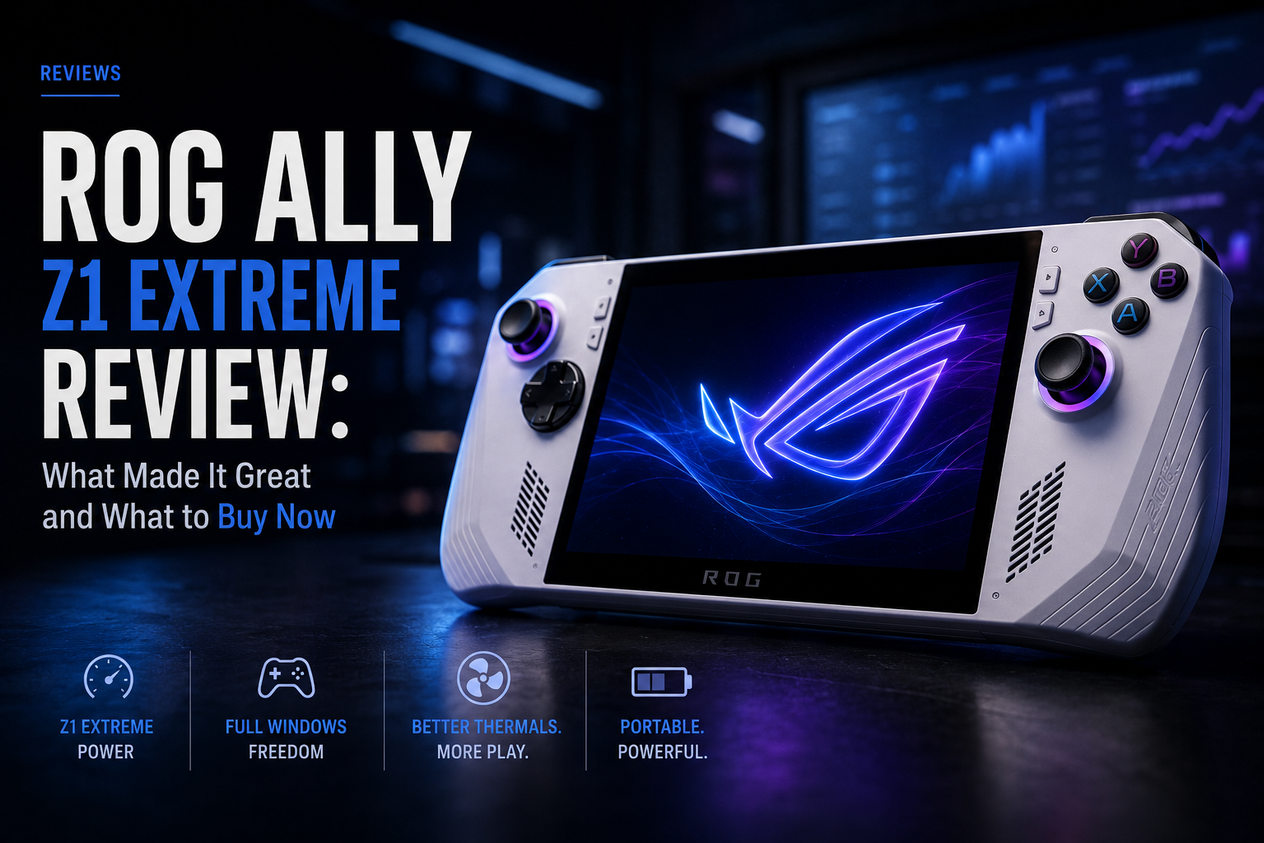
When ASUS launched the ROG Ally Z1 Extreme in May 2023, it did something no Windows handheld had managed before: it made a genuine case that a portable PC could compete with the Steam Deck. Not just on paper — in real gaming sessions, at a price that felt, if not cheap, at least defensible.
Three years later, the Z1 Extreme is discontinued at retail. ASUS replaced it with the ROG Xbox Ally lineup, co-developed with Microsoft. Used and open-box Z1 Extremes sell for $375–$486 on the secondary market. The question has shifted from “should I buy this?” to “was it actually as good as people said — and does any of that matter when choosing a handheld in 2026?” Both questions are worth answering.
ROG Ally Z1 Extreme: Specs
| Spec | Detail |
|---|---|
| Launch price | $699 (May 2023) |
| Current price (2026) | $375–$486 used / open-box |
| Chip | AMD Ryzen Z1 Extreme (Zen 4, 8 cores / 16 threads) |
| GPU | AMD RDNA 3, 12 Compute Units, up to 8.6 TFLOPs |
| RAM | 16GB LPDDR5 |
| Storage | 512GB NVMe (M.2 2230, user-replaceable) |
| Display | 7" IPS, 1920×1080, 120Hz, VRR (FreeSync Premium) |
| Battery | 40Wh |
| Battery life (AAA) | ~1.5–2 hours |
| Battery life (light) | ~3–5 hours |
| OS | Windows 11 Home |
| Weight | 608g |
| USB | 1× USB-C 3.2 Gen 2 |
| microSD | Yes (UHS-II) |
What Made the ROG Ally Z1 Extreme Special
The Chip Was a Genuine Leap
The Ryzen Z1 Extreme was AMD's first chip designed specifically for gaming handhelds — not repurposed laptop silicon, but a custom Zen 4 + RDNA 3 APU built to operate efficiently between 9W and 30W. When adjusting power configurations, the chip proved very robust: delivering good battery performance at low power while outperforming the Ryzen 7 7840U laptop chip at higher TDP levels. In practical terms, the Z1 Extreme had meaningful headroom at 25–30W Turbo mode that the Steam Deck's older Van Gogh APU simply couldn't match — reviewers consistently found a 5–10 FPS advantage over the Steam Deck in demanding titles at matched resolutions.
The Display Set a New Bar
Before the ROG Ally, handheld gaming screens were a compromise. The Steam Deck's 800p LCD was functional but not exciting. The Z1 Extreme shipped with a 7-inch 1080p 120Hz IPS panel with FreeSync Premium VRR — the first handheld to offer it. Text was sharp, motion was smooth, and VRR meant frame rate dips between 40 and 80 FPS felt far smoother than a fixed-refresh display would allow. That display remained a reference point for every handheld that followed it.
Windows Was Both the Strength and the Weakness
Full Windows 11 meant the Z1 Extreme ran every PC game — Steam, Epic, Battle.net, Xbox Game Pass, anything. That was a meaningful advantage over the Steam Deck's Linux-based SteamOS, which at launch had compatibility gaps and required Proton workarounds for many titles. The flip side was that Windows wasn't designed for a 7-inch touchscreen. Setup took work, drivers needed managing, and ASUS's Armoury Crate overlay helped but didn't fully solve the friction. Every reviewer noted this — it was the Z1 Extreme's defining tension.
ROG Ally Z1 Extreme: Real-World Gaming Performance
At 15W balanced mode, the Z1 Extreme handled the majority of the 2023 games library at medium-to-high settings. At 25–30W Turbo plugged into power, it pushed further:
| Game | Settings | FPS (approx., 25W Turbo) |
|---|---|---|
| Elden Ring | 1080p Medium | 45–55 FPS |
| Fortnite | 1080p Medium | 55–70 FPS |
| Cyberpunk 2077 | 1080p Low | 28–38 FPS |
| F1 22 | 1080p High | 80–90 FPS |
| Hades | 1080p High | 60+ FPS |
CPU-intensive titles like Starfield exposed the ceiling clearly — sub-30 FPS averages even at low settings and FSR performance mode at 1080p. The chip was capable but not limitless. The thermal design, however, was well executed: the device never felt hot where you held it, with air pulled through vents in the back and expelled from the top. In Turbo mode it got loud, but with headphones you wouldn't notice.
Battery Life: The Z1 Extreme's Weakest Point
The 40Wh battery was widely criticised. At 15W balanced mode, expect 3–5 hours of lighter titles. At 25–30W Turbo — where the chip performs best — that drops to around 1.5–2 hours. For a device designed around portability, that was a genuine limitation. This remained the Z1 Extreme's most significant weakness relative to the Steam Deck OLED (50Wh, 6–10 hours on indie titles) and later competition. Every successor ASUS built addressed it — the ROG Xbox Ally X ships with an 80Wh battery.
What the ROG Ally Z1 Extreme Got Right
- Display — still one of the best IPS panels in the handheld category
- Chip performance — Zen 4 + RDNA 3 held up well; still relevant in 2026 at moderate workloads
- Build quality — premium chassis, good grip ergonomics, comfortable for long sessions
- Repairability — M.2 2230 SSD is user-replaceable; many owners upgraded to 2TB
- Full Windows library — every launcher, every game, Game Pass included
What It Got Wrong
- Battery — 40Wh was too small for a gaming handheld from day one
- Windows friction — SteamOS remains a better handheld OS experience
- Single USB-C port — the MSI Claw A1M launched later with two Thunderbolt 4 ports; one port felt limiting
- Heat under Turbo — fans got loud; the thermal envelope was tight
Should You Buy a ROG Ally Z1 Extreme in 2026?
Used ROG Ally units typically sell for 20–40% below retail MSRP on secondary markets, with the original Ally seeing the biggest discounts. At $375–$486 in August 2026, the Z1 Extreme is priced as a budget entry point into Windows handheld gaming.
| Scenario | Recommendation |
|---|---|
| Budget under $450 | Z1 Extreme used — solid chip, great display, full Windows library |
| Budget $599 | ROG Xbox Ally new — newer platform, 80Wh battery, better long-term value |
| Budget $999+ | ROG Xbox Ally X — 24GB RAM, Ryzen AI Z2 Extreme, best current Windows handheld |
| Steam-only library | Steam Deck OLED — SteamOS is a better handheld OS at any budget |
The Z1 Extreme's 40Wh battery is its most painful compromise in 2026. If you game primarily near a power source, it matters less. If you want genuine portability — sessions away from a plug — the 80Wh battery in the ROG Xbox Ally X is transformative by comparison.
What Replaced the ROG Ally Z1 Extreme
ROG Xbox Ally ($599)
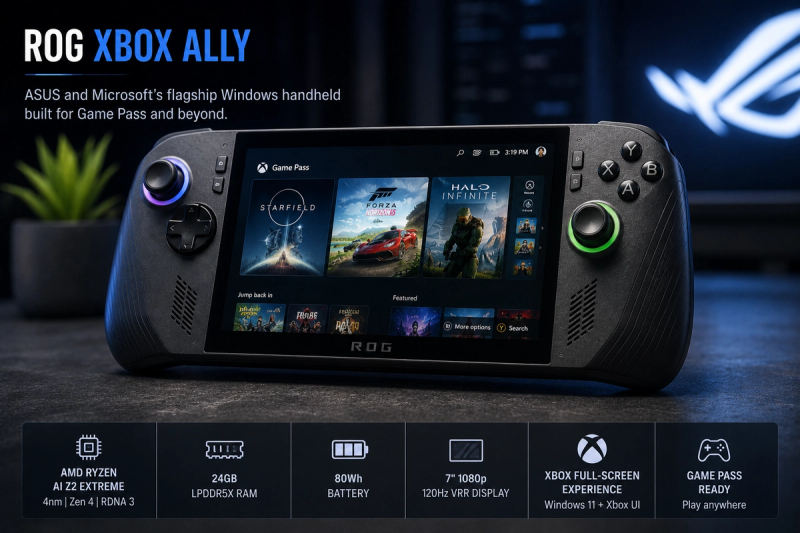
Runs the AMD Ryzen Z2 A chip, 80Wh battery, same 7-inch 1080p 120Hz display with Xbox UI on top of Windows 11. Better battery, newer platform, $113–$111 more than a used Z1 Extreme.
ROG Xbox Ally X ($999.99)
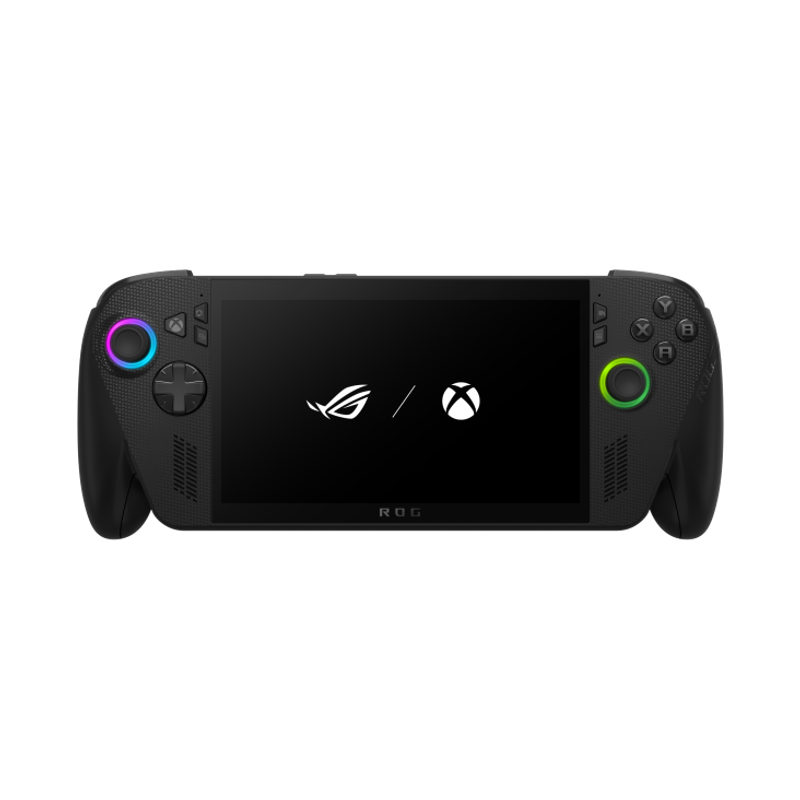
The full successor. AMD Ryzen AI Z2 Extreme, 24GB LPDDR5X RAM, 80Wh battery, USB4, Hall Effect joysticks. Roughly 20–30% faster than the Z1 Extreme in gaming workloads. The device the Z1 Extreme was always pointing toward.
For a full comparison of where both sit in the current market, see our best handheld gaming PC 2026 roundup and our Steam Deck vs ROG Ally comparison.
The Verdict
The ROG Ally Z1 Extreme earned its reputation. It was the first Windows handheld that felt like a finished product — a 1080p 120Hz display, a chip with real gaming headroom, and a build quality that justified the $699 launch price. It set the template every competitor responded to.
In 2026 it's a used device with a small battery and a single USB-C port, selling at $375–$486. At that price it's still a capable handheld for buyers who primarily game at lower TDP and don't need multi-hour unplugged sessions. For anyone who can stretch to $599, the ROG Xbox Ally new is the smarter buy — more battery, newer platform, no compromise.
The Z1 Extreme didn't need to last forever. It just needed to be good enough to change what buyers expected from a handheld. It did that.