Legion Go S vs Steam Deck in 2026: Which SteamOS Handheld Should You Buy?
Legion Go S vs Steam Deck OLED in 2026: price, display, performance, battery, and controls compared after Valve's price hike. Which SteamOS handheld to buy.
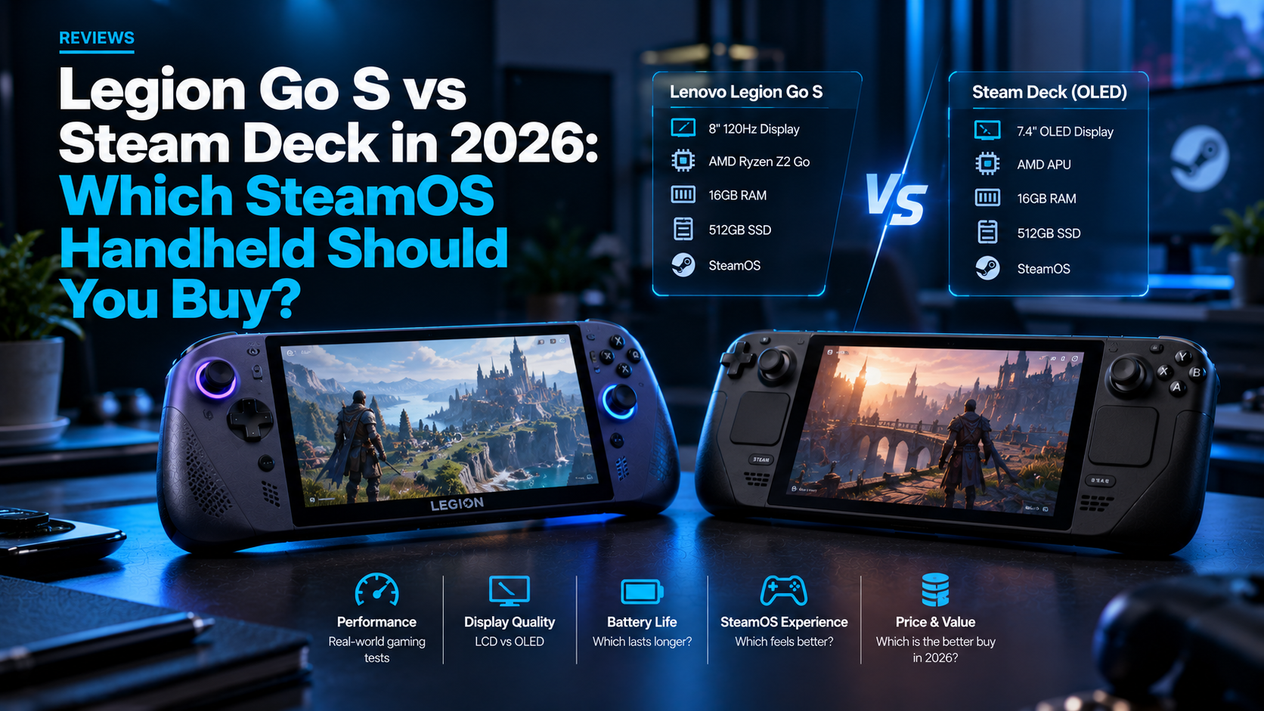
The Lenovo Legion Go S was the first third-party handheld to ship with SteamOS, and for most of 2025 it sat in an awkward spot: similar money to the Steam Deck OLED, but with an IPS screen instead of OLED. Valve’s May 2026 price increase changed that. With the Steam Deck OLED now at $789, the entry Legion Go S SteamOS model is the cheaper way to get Valve’s operating system on a new device. This comparison covers which one to buy in 2026 — and the one case where the Deck is still the clear winner.
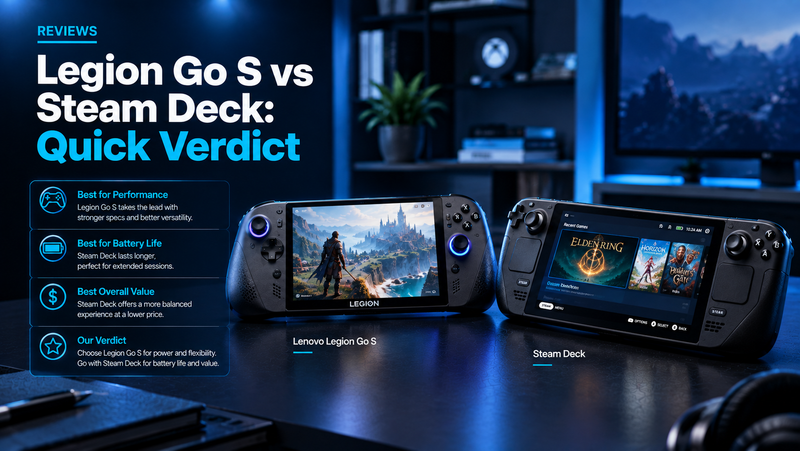
Legion Go S vs Steam Deck: Quick Verdict
| Category | Winner | Why |
|---|---|---|
| Price (2026) | Legion Go S (Z2 Go) | Undercuts the $789 Steam Deck OLED |
| Display quality | Steam Deck OLED | OLED contrast and HDR beat the Go S’s IPS panel |
| Screen size and sharpness | Legion Go S | 8" 1920×1200 120Hz vs 7.4" 1280×800 90Hz |
| Battery efficiency | Steam Deck OLED | Smaller 50Wh cell but a more efficient chip |
| Weight and comfort | Steam Deck OLED | ~640g vs ~730–740g |
| Controls | Split | Deck has two trackpads; Go S has Hall effect sticks (drift-resistant) |
| Ports | Legion Go S | Two USB4 ports vs one USB-C |
| Software | Tie | Both run SteamOS |
Legion Go S vs Steam Deck OLED: Specs and Price
| Spec | Legion Go S SteamOS (Z2 Go) | Legion Go S SteamOS (Z1 Extreme) | Steam Deck OLED |
|---|---|---|---|
| Launch price | $549.99 (May 2025) | $749.99 (May 2025) | $549 / $649 (Nov 2023) |
| Typical 2026 price | ~$599–649 | ~$829 | $789 (512GB) / $949 (1TB) |
| Chip | AMD Ryzen Z2 Go (4-core) | AMD Ryzen Z1 Extreme (8-core Zen 4) | Custom AMD APU (4-core Zen 2) |
| RAM / storage | 16GB / 512GB | 32GB / 1TB | 16GB / 512GB or 1TB |
| Display | 8" IPS, 1920×1200, 120Hz VRR | 8" IPS, 1920×1200, 120Hz VRR | 7.4" HDR OLED, 1280×800, 90Hz |
| Battery | 55.5Wh | 55.5Wh | 50Wh |
| Weight | ~730–740g | ~730–740g | ~640g |
| Trackpads | None | None | Two capacitive trackpads |
| Ports | 2× USB4, microSD | 2× USB4, microSD | 1× USB-C, microSD |
Pricing on both devices moved in 2026 as memory costs rose. Check current retailer prices before buying — the gap between the entry Legion Go S and the Steam Deck OLED has ranged from roughly $140 to $190.
Display: Bigger and Sharper vs Better Contrast
This is the core trade-off. The Legion Go S has a larger 8-inch screen with a higher 1920×1200 resolution and a faster 120Hz refresh rate with variable refresh. Text is crisper and there’s more screen to look at. The Steam Deck OLED’s 7.4-inch panel is lower resolution, but OLED gives true blacks, far higher contrast, and real HDR — games look more vivid, especially in dark scenes. If picture quality matters most, the Deck wins. If size and sharpness matter more, the Go S wins.
Performance: Which Is Faster?
The entry Legion Go S uses AMD’s newer Ryzen Z2 Go chip, but it’s still a 4-core part in the same broad performance class as the Steam Deck. In practice the two trade blows: neither is built for demanding 2026 AAA games at high settings, and both rely on low settings and upscaling for the newest releases. The Steam Deck’s chip is more power-efficient, which shows up in battery life. The upper Legion Go S configuration with the 8-core Ryzen Z1 Extreme is a genuine step up in performance, but at around $829 it now costs more than the Steam Deck OLED.
One advantage both share: SteamOS runs games more efficiently than Windows on the same hardware. Testing of the Legion Go S found its SteamOS version faster and longer-lasting than the Windows version of the identical device.
Battery Life and Comfort
The Legion Go S has a slightly larger 55.5Wh battery, but its bigger, brighter screen and less efficient chip mean real-world battery life is broadly similar to the Steam Deck OLED, and often a little shorter in lighter games. The Deck is also about 90–100g lighter, which matters in long handheld sessions. The Go S counters with Hall effect thumbsticks that resist drift over time; the Deck’s sticks aren’t Hall effect but are easy to replace.
Controls: The Trackpad Question
The Steam Deck’s two trackpads are its most underrated feature. They make mouse-driven games — strategy, simulation, point-and-click, older PC titles — genuinely playable, and help in the SteamOS desktop mode. The Legion Go S has no trackpads and relies on the touchscreen instead. If your library leans on strategy games or mouse-first titles, this alone can decide it in the Deck’s favour.
Legion Go S or Steam Deck: Which Should You Buy?
| Buy the Legion Go S (Z2 Go) if… | Buy the Steam Deck OLED if… |
|---|---|
| You want the cheapest new SteamOS handheld | Screen quality and HDR matter most to you |
| You prefer a larger, sharper 8-inch screen | You play strategy or mouse-driven games (trackpads) |
| You want two USB4 ports for docking and accessories | You want the lightest, most efficient handheld |
| Drift-resistant Hall effect sticks matter to you | You’ll buy refurbished — a certified OLED is $629 |
Skip the Z1 Extreme Legion Go S at around $829 unless you specifically need its extra performance — at that price the Steam Deck OLED is cheaper, and a Windows handheld like the ROG Xbox Ally X offers more power. For more on the Deck after its price rise, see our Steam Deck OLED guide.
Frequently Asked Questions
Is the Legion Go S the same as the Legion Go 2?
No. The Legion Go S is Lenovo’s smaller, cheaper handheld with a fixed-controller design. The Legion Go 2 is the premium model with an 8.8-inch OLED screen, detachable controllers, and a $1,199 starting price. See our ROG Ally vs Legion Go comparison for the flagship matchup.
Does the Legion Go S run the same games as the Steam Deck?
The SteamOS version runs the same Steam library with the same compatibility. Games with anti-cheat that blocks SteamOS won’t work on either. A Windows version of the Legion Go S also exists and costs more.
Is there a cheaper Windows alternative?
Yes — the base ROG Xbox Ally often sells for $499.99 and suits Game Pass players. See our ROG Xbox Ally review.
The Verdict
In 2026, the entry Legion Go S SteamOS model is the value pick: the same software as the Steam Deck, a bigger and sharper screen, and a lower price than a new Steam Deck OLED. The Steam Deck OLED is still the better handheld to use — lighter, more efficient, with a superior OLED display and trackpads — and it’s the right choice if you can pay more or buy refurbished. Both are Steam-first devices; if Game Pass is your main library, look at a Windows handheld instead.
For every option ranked, see our best handheld gaming PC roundup and our Steam Deck vs ROG Ally comparison.