MSI Claw 8 EX AI+ vs ROG Xbox Ally X: the performance king vs the smart buy
Intel's Arc G3 Extreme trades blows with AMD's Z2 Extreme in the handheld gaming PC fight of 2026 — one dominates raw performance, the other wins on price, software maturity, and portability.
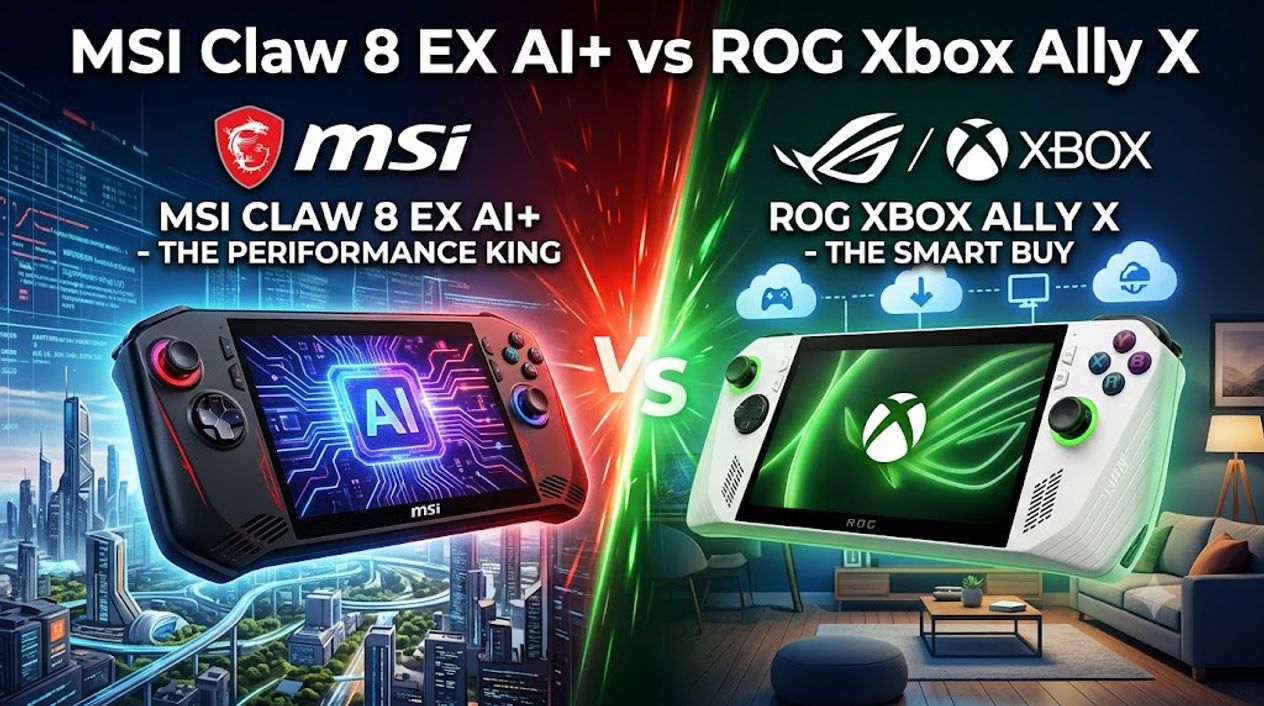
The gaming handheld market in 2026 has a new tension at its core: Intel is back, and this time it means it. For three years, AMD's Ryzen silicon powered every credible Windows handheld — the Steam Deck, ROG Ally, and Lenovo Legion Go all ran custom AMD chips. That changed in June 2026, when MSI shipped the Claw 8 EX AI+, the first device built on Intel's Arc G3 Extreme, a chip designed from scratch for handheld gaming rather than repurposed from a laptop line.
Its rival — the ROG Xbox Ally X — runs AMD's Ryzen AI Z2 Extreme and costs $999.99. The Claw 8 EX AI+ costs $1,799. That $800 gap is the real question this comparison has to answer: what do you get for it, and is it worth it? Part of that price story is a wider market shift: memory chip shortages are driving handheld and smartphone prices up across the board in 2026, and both devices sit at the expensive end of a market that is broadly getting costlier.
- The Claw 8 EX AI+ is faster — reviewers measured an average 41% frame-rate lead at 35W across a 36-game suite vs the ROG Xbox Ally X
- At 17W, the Arc G3 Extreme matches the Z2 Extreme running at full 35W — roughly double the performance per watt
- The ROG Xbox Ally X costs $999.99 vs $1,799 for the Claw — an $800 difference for roughly 1.7× the frame rates
- Both run Windows 11 with the Xbox Full Screen interface; software experience is near-identical day to day
- The Ally X is lighter (715g vs 785g), charges faster (100W vs 65W PD), and has a more mature AMD driver ecosystem
- The Claw has a larger 8″ display, more RAM (32 vs 24 GB), faster Wi-Fi 7, and dual Thunderbolt 4
Specs side by side
All figures from manufacturer specifications and independent reviews. Not sure what the RAM and storage numbers mean in practice? Our RAM vs storage explainer breaks down exactly what each one affects in everyday use.
| Spec | MSI Claw 8 EX AI+ | ROG Xbox Ally X |
|---|---|---|
| Price | $1,799 | $999.99 |
| Chip | Intel Arc G3 Extreme (Panther Lake) | AMD Ryzen AI Z2 Extreme |
| CPU cores | 14c (2P + 8E + 4LP E) | 8c Zen 5 |
| GPU | Arc B390 — 12 Xe3 cores | Radeon 890M — 16 RDNA 3.5 CUs |
| Display | 8″ IPS, 1920×1200, 120Hz VRR | 7″ IPS, 1920×1080, 120Hz VRR |
| RAM | 32 GB LPDDR5X-8533 | 24 GB LPDDR5X-8000 |
| Storage | 1 TB M.2 2280 (upgradeable) | 1 TB M.2 2280 |
| Battery | 80 Wh | 80 Wh |
| Wired charging | Up to 65W PD | 100W PD |
| Connectivity | 2× TB4, Wi-Fi 7, BT 6.0 | USB4 + USB 3.2, Wi-Fi 6E, BT 5.2 |
| Weight | 785 g | 715 g |
| OS / UI | Windows 11 + Xbox Full Screen | Windows 11 + Xbox Full Screen |
Performance: Intel’s biggest handheld lead yet
This is where the Claw 8 EX AI+ makes its case. Across independent reviews, the Arc G3 Extreme consistently beat the AMD Ryzen AI Z2 Extreme in the ROG Xbox Ally X by margins that surprised even reviewers who expected Intel to lead.
Notebookcheck measured the Arc G3 Extreme GPU at roughly 50–60% ahead of the Z2 Extreme in gaming workloads. BTR, running a 36-game suite at 1080p with 2× upscaling, found a 41% geomean advantage for the Claw at equal 35W TDP. XDA-Developers recorded 71 fps in Shadow of the Tomb Raider on the Claw against 43 fps on the Ally X. Engadget cited 50–75% frame-rate improvements across its test titles. For a deeper look at what those reviewers concluded overall, see our MSI Claw 8 EX AI+ review roundup.
“At 17 watts the Arc G3 Extreme matches an AMD Z2 Extreme pulling a full 35. That single fact reframes what a handheld can do with a constrained power budget.”
— BTR, June 2026
The efficiency story is arguably more important than raw performance. BTR's benchmark found that the Arc G3 Extreme at 17W matches the Z2 Extreme at 35W — a geomean ratio of 1.005×, essentially identical performance at half the power draw. The practical result: longer battery life without giving up frame rates. Notebookcheck reported the Claw 8 EX AI+ running Cyberpunk 2077 at 1200p with Ultra settings and 4× frame generation at around 90 fps in Endurance mode (14W chip power, around 21W total system draw), with close to four hours of battery runtime. If you want to squeeze every minute out of either device, our guide to extending phone and handheld battery life covers the settings that actually move the needle.
Selected benchmark results — Claw 8 EX AI+ vs ROG Xbox Ally X
Sources: BTR (36-game suite), Engadget, XDA-Developers, Notebookcheck. Intel-provided Computex figures are labelled.
| Title / Setting | Claw 8 EX AI+ | ROG Xbox Ally X | Delta |
|---|---|---|---|
| Cyberpunk 2077 (RT Low, 1080p) | 44 fps (Claw) | 25 fps (Ally X) | ~76% faster |
| Shadow of Tomb Raider (Med, 1080p) | 71 fps (Claw) | 43 fps (Ally X) | ~65% faster |
| Forza Horizon 5 (1080p) | 61 fps (Claw) | 57 fps (Ally X) | ~7% faster |
| Returnal (FHD, 17W, Med) | 59 fps (Claw) | 42 fps (Ally X) | ~40% faster |
| Clair Obscur Exp. 33 (17W, Med) | 45 fps (Claw) | 30 fps (Ally X) | ~50% faster |
| Geomean, 36-title suite @ 35W | Baseline = Claw | −41% slower | Intel 41% ahead |
| Geomean, 36-title suite @ 17W | Baseline = Claw | −20% slower | Intel 20% ahead |
| Arc G3 @ 17W vs Z2 @ 35W | Dead-even (1.005×) | — | Same perf, half the power |
Frame generation (XeSS MFG) results are a smoothness metric, not raw raster equivalent. Intel-vendor Computex figures are cross-checked against third-party measurements above before being included.
Display: bigger on the Claw, sharper on the Ally
The Claw 8 EX AI+ carries an 8-inch IPS panel at 1920×1200 (16:10 aspect ratio), giving you around 38% more usable screen area than the Ally X's 7-inch 1920×1080 (16:9) panel. Both run at 120Hz with VRR support and peak at 500 nits. The extra screen real estate is immediately noticeable in text-heavy menus and UI-intensive games.
Neither device uses OLED, which is a notable omission at these price points — the Lenovo Legion Go 2, which costs $1,199, offers an 8.8-inch OLED panel. The Ally X’s IPS is slightly brighter in measured testing according to HotHardware. Both are perfectly usable; neither will make you forget you’re looking at LCD.
Design, comfort, and build
The ROG Xbox Ally X weighs 715g, the Claw 8 EX AI+ comes in at 785g. Over a long gaming session, that 70g difference is perceptible. The Ally X’s Xbox-controller-inspired ergonomics are widely praised as among the most comfortable in the category; Windows Central called it "an ergonomic wonder." The Claw redesigned its chassis for the EX AI+ generation, and reviewers from Windows Central and Engadget noted the result is more comfortable than its predecessor, though it hasn't displaced the Ally X as the gold standard for in-hand feel.
Both devices use Hall Effect analog sticks and triggers, which resist the joystick drift that has affected older handhelds. Both have RGB lighting around the sticks. The Claw’s larger body means the screen sits proud of the bottom edge rather than being fully enclosed — a distinctive visual that reviewers called "clunky-looking but surprisingly well-balanced" in practice.
Software: Xbox Full Screen on both, but AMD has the driver edge
A year ago, software was the clearest edge for AMD-based handhelds. Today, both the Claw 8 EX AI+ and the ROG Xbox Ally X boot into the Xbox Full Screen Experience, a console-style interface that overlays Windows 11, integrates Game Pass natively, and keeps most users away from the Windows desktop entirely. The day-to-day experience is functionally similar on both devices.
The meaningful software difference is at the driver level. AMD’s graphics drivers have been optimised for handheld gaming for several years, with near-universal FSR support and stable performance across a wide game library. Intel’s Arc drivers have improved dramatically since the troubled first-generation Claw, with over 200 titles receiving Day-0 driver support and more than 110 XeSS multi-frame generation-compatible games at launch. But Intel is still catching up to AMD’s compatibility breadth, and some older or niche titles may behave better on the Z2 Extreme. The Ally X also has the option of running Bazzite (a SteamOS-based Linux distribution), which TechRadar found “significantly better than Windows 11 for handheld gaming” on AMD hardware — an option not yet available for Arc G3 devices. Whichever platform you land on, both devices ship with broad telemetry defaults enabled; it is worth reviewing your device privacy settings before signing into Game Pass or any cloud service.
Battery life: Claw wins on efficiency, Ally X on charging speed
Both devices carry an 80Wh battery. The Claw’s efficiency advantage means more real-world game time for equivalent frame rates. The Shortcut’s testing found the Claw 8 EX AI+ outlasting every handheld it had tested on a standardised battery benchmark, with over three hours in Battlefield 6 and close to ten hours in Hades II using Intel’s low-power Endurance mode at 14–17W.
The ROG Xbox Ally X charges at 100W over USB-C Power Delivery, taking the device from near-empty to usable in around 30–40 minutes. The Claw 8 EX AI+ currently charges at up to 65W PD. Both are faster than most laptops, but the Ally X’s charging speed advantage is a real-world edge for travel. Neither device supports wireless charging natively — if the wireless charging ecosystem interests you generally, we have a plain-language breakdown of what Qi2 is and which devices support it.
Connectivity: Claw pulls ahead
The Claw 8 EX AI+ includes two Thunderbolt 4 ports with full 40 Gbps bandwidth, DisplayPort output, and Power Delivery — meaning you can connect an eGPU, a 4K monitor, or a multi-port USB hub from a single cable. It also has Wi-Fi 7 and Bluetooth 6.0, and a microSD Express slot supporting over 800 MB/s card transfers. TechPowerUp flagged one connectivity concern: Wi-Fi lag spikes occurring roughly every ten minutes during local game streaming, attributed to a known Intel Wi-Fi scanning issue. If you run into network dropouts on either device, our Wi-Fi troubleshooting guide covers the systematic fixes to try before blaming the hardware.
The ROG Xbox Ally X has one USB4 port (40 Gbps) and one USB 3.2 port, Wi-Fi 6E, and Bluetooth 5.2. Its microSD slot does not support the Express standard. For most gaming use the Ally X’s connectivity is perfectly adequate; the Claw’s Thunderbolt 4 pairing and Wi-Fi 7 are meaningful advantages mainly for users who also want to use the device as a desktop PC replacement or frequently dock it.
Pros and cons
CLAW 8 EX AI+:
- Fastest gaming handheld tested by multiple independent reviewers in 2026
- Arc G3 Extreme averages 41% ahead of Z2 Extreme at equal 35W across a 36-game suite
- 8″ 1920×1200 display is noticeably larger than the Ally X’s 7″ panel
- More RAM (32 vs 24 GB) and faster Wi-Fi 7 + dual Thunderbolt 4
- Efficiency lead: 17W performance matches Z2 Extreme at 35W, extending battery life
- $1,799 is $800 more than the Ally X — twice the price for ~1.4× the performance
- No OLED display despite the premium price
- Intel Arc drivers still maturing; some older titles behave better on AMD
- Heavier at 785g vs 715g for the Ally X
- Slower charging (65W vs 100W PD) and intermittent Wi-Fi streaming lag reported
ROG XBOX ALLY X :
- $999.99 is $800 less — strong gaming performance at a realistic price
- Lighter and more compact (715g, 7″) with Xbox-controller ergonomics widely praised
- Faster 100W PD charging
- AMD Z2 Extreme has a mature, battle-tested driver ecosystem and near-universal FSR support
- Bazzite/SteamOS option available for the Linux-first crowd
- Trails the Claw 8 EX AI+ by ~41% in gaming performance at matched power settings
- Smaller 7″ display at 1080p vs the Claw’s 8″ 1200p panel
- Less RAM (24 vs 32 GB) and older Wi-Fi 6E + USB 3.2 on the second port
- No Thunderbolt 4 or microSD Express slot
- FSR 4 upscaling not available on Z2 Extreme’s RDNA 3.5 GPU (FSR 3.1 only)
Who should buy which
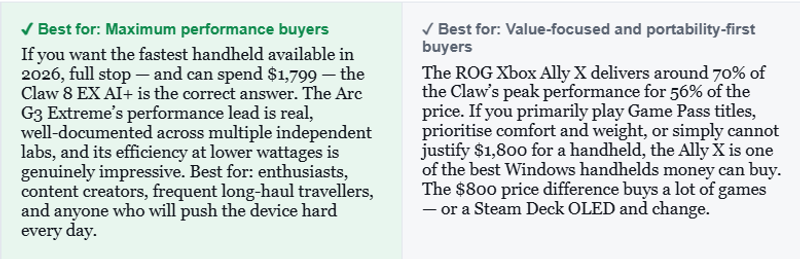
There is a third option worth naming: the MSI Claw A8 ($1,299), which runs the same Z2 Extreme chip as the Ally X in the Claw’s 8-inch body with 24 GB of RAM, an upgradeable SSD, and dual Thunderbolt 4. For buyers who want the larger screen and better connectivity without paying the full EX AI+ premium, it is a competitive middle ground.
Verdict
The MSI Claw 8 EX AI+ is the fastest gaming handheld tested to date. The Arc G3 Extreme's performance lead over AMD’s Z2 Extreme is consistent across every independent review we found, and its efficiency advantage — matching Z2 Extreme performance at half the power — gives it meaningfully longer battery life in practice. If raw performance is what you are buying, it delivers.
But the ROG Xbox Ally X remains a genuinely excellent device. It costs $800 less, weighs less, charges faster, and runs a more mature driver stack. For the majority of players, the performance gap does not justify the price gap. The Claw 8 EX AI+ is the right buy for a specific, high-budget buyer; the Ally X is the right buy for almost everyone else. Whichever you pick, setting it up well from day one matters — our 10 tech habits everyone should have covers the security and backup basics that apply to any new Windows device.
“It’s not a huge leap from the Z2 Extreme found in the ROG Xbox Ally X — but those with deep pockets will get the best PC gaming handheld around.”
— XDA-Developers, June 2026
Compiled from independent third-party reviews and manufacturer specifications as of July 4, 2026. Prices are US retail prices at time of writing; check current pricing before purchasing. This article is general information, not a purchasing recommendation tailored to individual circumstances.