When Will Smartphone Prices Drop? What Seven Forecasts Actually Say
Seven forecasts from analysts and chip executives agree: smartphone prices are unlikely to fall before 2028. Here is why, how much they have risen, and whether to buy now.
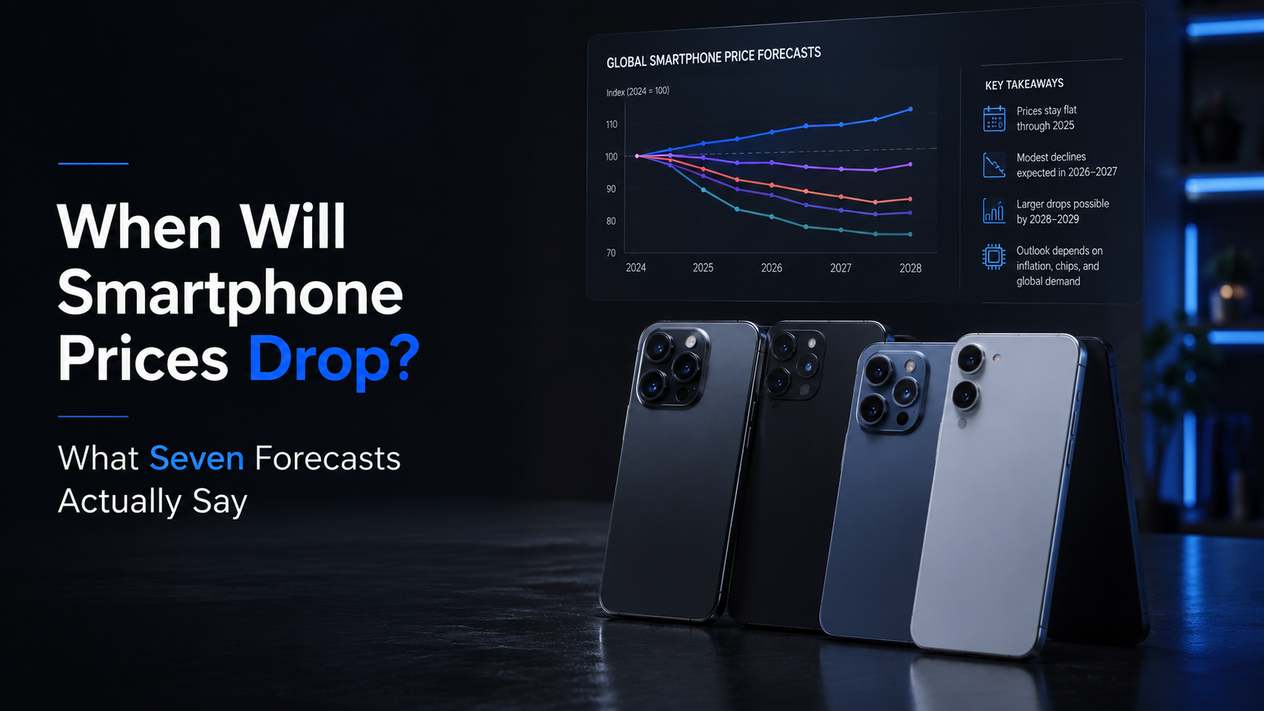
Key Takeaways: When Phone Prices Will Fall
- Seven separate forecasts from analysts and chip executives point to the same answer: not in 2026, and probably not in 2027 either
- Gartner expects smartphone prices to end 2026 around 13% above 2025 levels, driven by a projected 130% surge in combined DRAM and SSD costs
- AI data centres are consuming roughly 70% of global memory output, and manufacturers have shifted the overwhelming majority of production toward high-bandwidth memory
- SK Hynix's CEO has called 2027 the worst year in the industry's history from a supply perspective; its internal analysis does not see stability before 2028
- New fabs are being built, but meaningful volume is not expected until late 2027 at the earliest, with real contribution in 2028
- The practical conclusion is uncomfortable: for most buyers, waiting for a better price is likely to cost more, not less
Phones got more expensive in 2026 and everyone noticed. The natural response is to wait — hold the current handset another year, buy when the market calms down, catch the inevitable correction.
The problem is that the correction has a date, and it is further away than almost anyone assumes. We went through every public forecast we could find from analyst firms and from the executives who actually run the memory factories. They disagree on the details. They agree on the shape.
Here is what they say, why this is happening, and what it means for when you should buy.
When Will Smartphone Prices Drop? Every Forecast Compared
Analyst houses and chip executives rarely line up this closely. The earliest credible date anyone gives is mid-2027, and most cluster around 2028.
| Source | Prediction | Earliest relief |
|---|---|---|
| IDC | RAM prices expected to stabilise by mid-2027; shortage persists through 2026 and well into 2027 | Mid-2027 |
| Counterpoint Research | Identifies Q4 2027 as the earliest inflection point | Q4 2027 |
| SK Hynix CEO (public) | Called 2027 the worst year in the industry's history from a supply perspective; has warned the crunch could last into the next decade | Beyond 2027 |
| SK Hynix (internal analysis) | DRAM market unlikely to stabilise before 2028, citing slow capacity expansion | 2028 |
| Micron CEO | Tight supply conditions expected to persist beyond 2027 | Beyond 2027 |
| Intel CEO | No relief until 2028 | 2028 |
| AMD (Computex 2026) | DDR5 pricing will not normalise until 2028 | 2028 |
Note who is saying what. The most pessimistic forecasts are not coming from analysts guessing at the market — they are coming from the companies that manufacture the memory. Those firms have every commercial incentive to project confidence about future supply, and they are not doing so.
Why Smartphone Prices Are Rising: The DRAM Shortage Explained
The mechanism is simple and it has nothing to do with phones. AI data centres need enormous quantities of memory, and high-bandwidth memory for AI accelerators earns manufacturers roughly three to five times the margin of conventional consumer DRAM.
Faced with a fixed amount of wafer capacity and two products with very different margins, Samsung, SK Hynix and Micron did the obvious thing. The consequences show up in these numbers:
- AI data centres now absorb roughly 70% of global memory chip output, a share expected to hold through 2026 and into 2027 — the hyperscaler capex boom driving it shows no sign of slowing
- The three major manufacturers have collectively shifted the overwhelming majority of production capacity toward high-bandwidth memory
- Conventional DRAM contract prices jumped roughly 90–95% in Q1 2026 against the previous quarter
- DRAM supply growth for 2026 is projected at around 16% year on year, against a historical norm of 20–30%
- Underinvestment during the 2022–23 downturn left no slack in the system when demand arrived
Memory is not a rounding error in a phone's cost. For a mid-range device it can represent 15–20% of the total bill of materials, and 10–15% for a flagship. When that component's price roughly doubles, the retail price has to move. Our guide to why phones are getting more expensive in 2026 covers the full cost breakdown.
How Much Have Smartphone Prices Actually Risen?
| Metric | Figure | Source |
|---|---|---|
| Smartphone price increase, 2026 vs 2025 | Around 13% | Gartner |
| PC price increase, 2026 vs 2025 | Around 17% | Gartner |
| Combined DRAM and SSD price surge by end of 2026 | Around 130% | Gartner |
| Smartphone average selling price change, 2026 | Up 6.9% year on year, revised from 3.6% | Counterpoint Research |
| Consumer device price increases by end of 2026 | 10–20% across PCs, tablets and smartphones | IDC |
| Global smartphone shipments, 2026 | Down 8.4% | Gartner |
| Memory share of laptop material costs | Around 35%, up from 15–18% a quarter earlier | HP |
Gartner described the resulting contraction in device shipments as the steepest in more than a decade. That matters for a reason that is easy to miss: falling shipments would normally push prices down. They are not, because the constraint is supply rather than demand.
💡 We track what tech actually costs, not what it launched at. Daybreak is a short weekly brief on the tech worth your money. Subscribe to Daybreak for free →
The Hidden Price Rise: Spec Downgrades
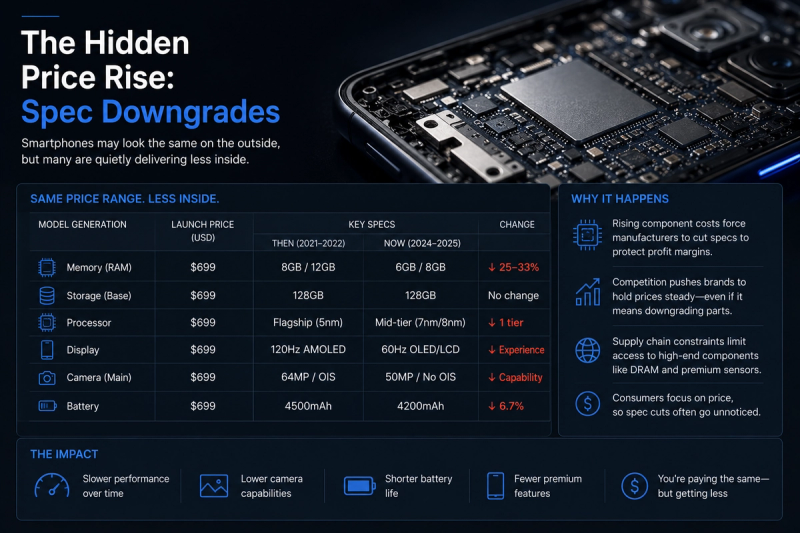
Sticker price is only half the story. Where manufacturers cannot raise prices without losing sales, they cut specifications instead — which is a price rise that does not appear on the price tag.
Analysts expect DRAM capacities in high-end and mid-range phones to sit near minimum viable standards through 2026, slowing the upgrade cycle that has run for a decade. The budget segment takes the worst of it, with base models expected to return to 4 GB of RAM — a specification the industry moved past years ago.
The decade-long trend of flagship features reaching affordable phones is reversing. If you are weighing configurations, our explainer on RAM versus storage on a phone is worth reading before you commit — the trade-offs matter more now than they did two years ago.
Why New Factories Will Not Fix This Quickly
Enormous amounts of money are being spent on new capacity. Samsung and SK Hynix are jointly investing hundreds of billions of dollars in new Korean memory fabs and a high-bandwidth memory hub. SK Hynix is building an HBM facility in Indiana. Micron is expanding across multiple sites.
None of it arrives soon. Semiconductor fabs take years, and the sequence is unforgiving:
| Facility | Meaningful output expected |
|---|---|
| New DRAM capacity generally | Coming online in 2027, but no meaningful output until the second half of that year |
| Substantial industry-wide bit contribution | Not expected until 2028 |
| Samsung P5, Pyeongtaek | Mass production targeted for late 2028 |
| Micron Idaho One | Mid-2027 |
| Micron Tongluo | Supply expected late 2027 into 2028 |
| Micron Singapore NAND fab | First wafer in the second half of 2028 |
There is a further catch. New cleanroom space faces exactly the same economics as existing space: high-bandwidth memory pays more per wafer, so high-bandwidth memory gets the wafers. Building more capacity does not automatically mean more consumer DRAM.
Reporting in early August indicated that Samsung, SK Hynix and Micron have already allocated their 2027 DRAM and high-bandwidth memory capacity, with long-term agreements locking up supply before the year has begun. If accurate, consumer DRAM availability in 2027 will be tighter than in 2026, not looser.
Should You Buy a Phone Now or Wait?
The instinct to wait out a price spike is usually correct. This is one of the cases where it probably is not, because the thing you would be waiting for is scheduled to get worse before it gets better.
- Buying now locks in current pricing before further increases land in the second half of 2026
- Current stock was largely built on memory bought at older, lower contract prices
- If your phone still works, not buying at all remains the cheapest option available
- Last-generation flagships bought now avoid both the price rise and the coming spec cuts
- Waiting makes sense only if you can wait until 2028
- Waiting for 2027 pricing means waiting into a year the industry expects to be tighter than 2026
- Every forecast we found puts genuine relief in 2028 at the earliest — that is two upgrade cycles away
- Spec downgrades mean a 2027 phone at the same price may carry less RAM than a 2026 one
- Discounting on older models is being reduced or removed as manufacturers protect margins
- Budget phones are the worst affected segment, so waiting hurts value buyers most
The practical guidance is narrower than usual. If you need a phone in the next twelve months, buying sooner is likely to cost less than buying later. If you do not need one, keeping what you have is the only strategy that reliably beats the market — and it beats it by a wide margin.
What does not work is waiting six months for a correction. There is no forecast on record that supports one.
Frequently Asked Questions
When will smartphone prices drop?
Not in 2026, and most likely not in 2027. IDC expects memory prices to stabilise by mid-2027 and Counterpoint points to Q4 2027 as the earliest inflection, while Intel, AMD and SK Hynix all point to 2028. Stabilising is also not the same as falling.
Why are phones more expensive in 2026?
AI data centres are consuming around 70% of global memory output, and manufacturers have redirected capacity toward high-bandwidth memory because it carries far higher margins. Memory makes up 10–20% of a phone's bill of materials, so the shortage passes straight through to retail prices.
How much more expensive are phones now?
Gartner projects smartphone prices ending 2026 around 13% above 2025 levels. IDC's range for consumer devices generally is 10–20%. Counterpoint puts the average selling price increase at 6.9% year on year.
Should I buy a phone now or wait for prices to fall?
If you need one within the next year, buy sooner rather than later — 2027 is expected to be tighter than 2026. If you do not need one, keeping your current phone is the cheapest option by a considerable margin.
Will phone specifications get worse?
In the budget segment, yes. Analysts expect base models to return to 4 GB of RAM in 2026, and mid-range and high-end DRAM capacities to sit near minimum standards rather than increasing.
Will new memory factories fix the shortage?
Eventually, but slowly. New capacity coming online in 2027 will not produce meaningful output until the second half of that year, with substantial contributions arriving in 2028. Samsung's P5 megafab targets mass production in late 2028.
The Bottom Line
| Question | Answer |
|---|---|
| Will prices drop in 2026? | No. Increases continue through the second half of the year |
| Will prices drop in 2027? | Unlikely. Supply is expected to be tighter than 2026; mid to late 2027 is the earliest anyone forecasts stabilisation |
| Will prices drop in 2028? | This is where the consensus sits, contingent on new fabs delivering and AI demand easing |
| Best move if you need a phone | Buy sooner rather than later; consider last-generation flagships |
| Best move if you don't | Keep your current phone. Nothing beats it on cost |
| What to avoid | Waiting six months for a correction that no forecast supports |
Sources
Every forecast and figure in this article, in full: Gartner's 2026 device shipment and pricing forecast, IDC's analysis of the memory shortage, IDC's updated PC and smartphone outlook, TrendForce on spec downgrades and 4 GB base models, Counterpoint Research on smartphone selling prices, SK Hynix's internal DRAM shortage projection, the DRAM fab capacity timeline, and reporting that 2027 memory capacity is already sold out.
Additional context from Reuters, Bloomberg, DigiTimes, and public statements by executives at SK Hynix, Micron, Intel and AMD. Forecasts accurate as of August 2026 and subject to revision as the supply picture develops.