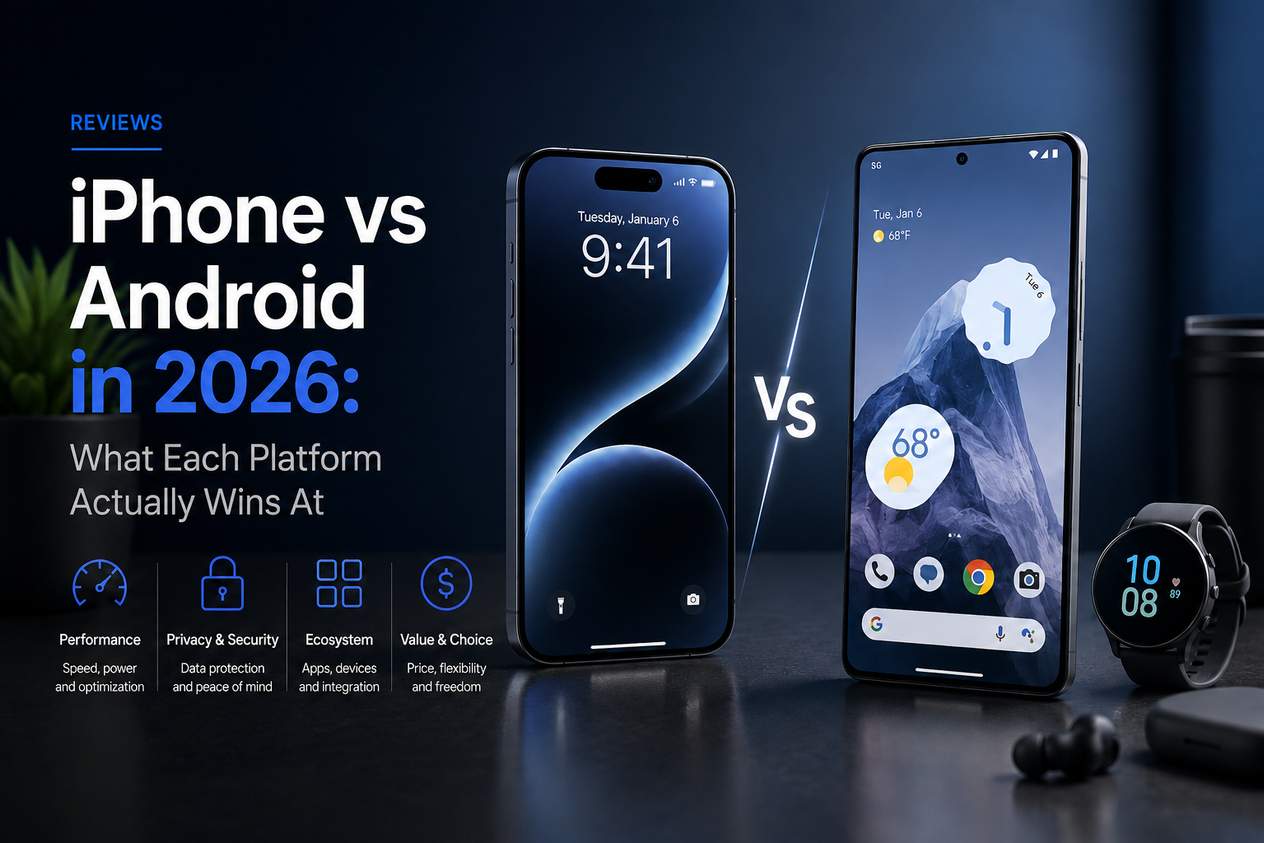
iPhone vs Android in 2026: What Each Platform Actually Wins At
iPhone vs Android in 2026: market share, camera, security, privacy, price, and a plain decision framework. Neither is objectively better — here is how to choose.
iPhone vs Android 2026: The Short Answer
- Android holds 72% of global market share; iPhone dominates the US with 58% — the choice depends heavily on which market you are in
- The technical gap between flagship iPhones and flagship Android phones is the smallest it has ever been in 2026
- iPhone wins on software support longevity (6+ years), resale value, security by default, and seamless Apple ecosystem integration
- Android wins on price flexibility, hardware variety, customization depth, charging speed, and choice of AI assistant
- Privacy in 2026 is more nuanced than the marketing suggests — both platforms track you, just in different ways and with different controls
- iOS 26 introduced the Liquid Glass UI; Apple Intelligence now rivals Google's AI breadth in most everyday tasks
- Switching between platforms is easier than ever, but ecosystem lock-in (iMessage, AirDrop, Apple Watch) is real and should factor into your decision
The iPhone vs Android debate has been running for fifteen years and the honest answer in 2026 is shorter than most comparison guides make it. The technical gap between the two platforms is the smallest it has ever been. Both deliver outstanding cameras, fast performance, and full AI integration. The decision is no longer which is better — it is which fits your life.
This guide covers every meaningful difference between iPhone and Android in 2026, what each platform actually wins at, the privacy question that most comparisons get wrong, and a decision framework at the end.
iPhone vs Android Market Share in 2026
The global picture and the US picture look completely different, and which one you are in shapes which platform you will find easier to live with.
| Market | Android share | iPhone share | Why it matters |
|---|---|---|---|
| Global | 72% | 28% | Android dominates at every price point in emerging markets |
| United States | 42% | 58% | iPhone is the majority platform; iMessage blue bubbles are a social reality |
| United Kingdom | ~47% | ~53% | iOS dominant; similar social dynamics to the US |
| India, Southeast Asia, Africa | 85%+ | Under 15% | Android dominates; budget hardware is the primary driver |
In a country where iPhone is the majority platform, choosing Android has social friction — green iMessage bubbles, missing AirDrop, and compatibility assumptions that do not apply to you. That friction is real even if it should not be.
iPhone vs Android Comparison 2026: Category by Category
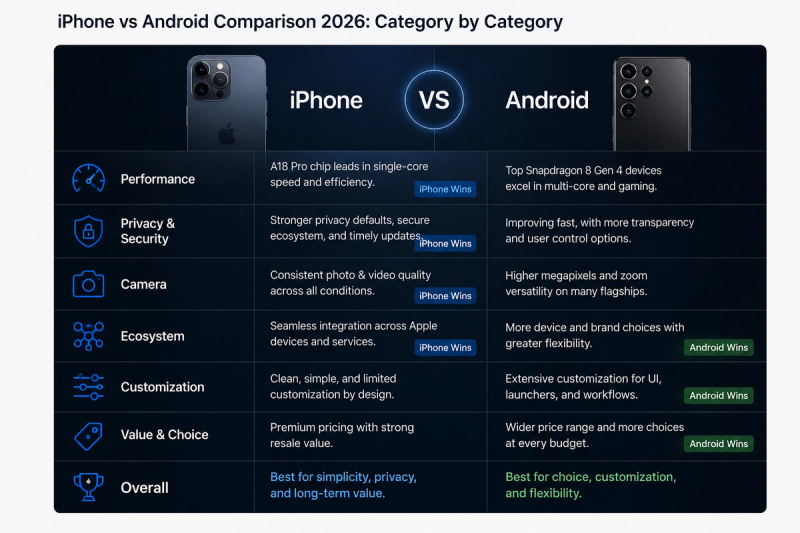
| Category | iPhone | Android | Winner |
|---|---|---|---|
| Software support | 6+ years of iOS updates (iPhone 16 series) | 3–5 years on flagship; 2–3 years on mid-range | iPhone |
| Price range | $429–1,599 (iPhone 16 range) | $100–1,300+ (hundreds of devices) | Android |
| Customisation | Limited — improving with iOS 26 but still restricted | Deep — launchers, default apps, sideloading, widgets | Android |
| Ecosystem | Tight: Mac, iPad, Apple Watch, AirPods, AirDrop, iMessage, Handoff | Open: Google, Samsung, Microsoft ecosystems all work | iPhone if you own Apple hardware; Android if you mix |
| Resale value | High — iPhones hold value 2–3 years | Varies widely; flagships drop faster | iPhone |
| Charging speed | Up to 30W wired, 25W MagSafe (iPhone 17) | Up to 100W+ on flagship Android | Android |
| Hardware variety | Limited — Apple controls every model | Hundreds of devices: foldables, stylus, rugged, budget | Android |
| App quality | Developers still launch on iOS first | Larger total app count; quality now comparable on flagships | Tie |
| AI assistant | Apple Intelligence with Siri (contextual, privacy-first) | Google Gemini (broader capabilities, more integrations) | Tie — depends on what you need |
| Gaming | Best single-core performance; console ports land first | More hardware options; better emulation freedom | iPhone for premium; Android for variety |
| Repairability | Improving with Apple’s self-repair programme | Varies — some brands excellent, some sealed | Android (generally) |
iPhone vs Android Camera in 2026
Camera comparisons dominated the iPhone vs Android debate for years. In 2026, both flagships deliver outstanding results and the gap has narrowed to specific scenarios rather than overall quality.
| Scenario | iPhone advantage | Android advantage |
|---|---|---|
| Video | iPhone remains the gold standard for handheld video; Log format, Cinema mode, Action mode | — |
| Consistency | Every iPhone photo looks good with no effort — processing is reliable | — |
| Zoom range | — | Flagship Android phones (Samsung, Vivo) lead on periscope zoom at 10–20× |
| Low light | Excellent — Photonic Engine competes with top Android | Pixel 9 and Samsung S25 Ultra competitive or better in some conditions |
| Customisation | — | More manual controls, RAW support across more apps, broader third-party camera app support |
If you primarily shoot video, iPhone is still the professional choice. If you want maximum zoom or more control over processing, the top Android flagships match or exceed it.
💡 Tech that affects your buying decisions, every week. Daybreak is a short Monday brief, free. Subscribe to Daybreak for free →
iPhone vs Android Security and Privacy in 2026
This is where most comparisons get it wrong by oversimplifying. The honest picture in 2026 is more nuanced than "iPhone is more private."
| Area | iPhone | Android |
|---|---|---|
| OS-level security | Controlled hardware + software = fewer attack surfaces; faster security patches to all devices | Varies by manufacturer; Google Pixels get fastest patches; others lag weeks to months |
| App store vetting | Stricter review; fewer malicious apps reach the App Store | More open; sideloading possible; Play Store less strict than App Store |
| Data collection | Apple collects less behavioural data and monetises it less directly | Google's business model is built on ad targeting; collects more by default |
| Privacy controls | App Tracking Transparency, Mail Privacy Protection, Private Browsing with advanced tracking protection | More granular permission controls per app; Google's My Ad Center for transparency |
| AI processing | Apple Intelligence runs most AI on-device; cloud requests are routed through Private Compute Cloud | Google processes more AI in the cloud by default; Gemini Nano handles some on-device |
| Vulnerability patching | Apple patches all supported iPhones simultaneously | Only Google Pixels and Samsung flagships receive rapid patches; mid-range Android may wait months |
iPhone is the better default for security if you want a platform that is safer out of the box with no configuration. Android's privacy on a Pixel running GrapheneOS is more customisable and arguably stronger for advanced users — but that requires deliberate setup.
Regardless of which you choose, the single most important thing you can do is enable two-factor authentication and use a password manager. Neither platform protects you from a compromised account on its own.
- 6+ years of software updates means your iPhone has a longer useful life
- Consistent security patches arrive to all supported iPhones at the same time
- Resale value is the strongest in the smartphone market
- Apple Intelligence processes most AI on-device, reducing cloud data exposure
- Tightest ecosystem integration if you own a Mac, iPad, or Apple Watch
- Video quality remains the benchmark for handheld smartphone video
- Liquid Glass UI in iOS 26 is polished and consistent across the OS
- Expensive entry point — cheapest new iPhone is $429; no genuine budget option
- Closed ecosystem makes leaving Apple expensive — losing iMessage, AirDrop, Apple Watch
- Less hardware variety — no foldables, no stylus, no ultra-rugged options from Apple
- Slower charging than flagship Android — 30W vs 100W+
- Less customisable — iOS 26 improves this but still restricted vs Android
- Repair costs higher at Apple, though self-repair programme is expanding
iPhone vs Android: Who Should Choose Which?
| Choose iPhone if you… | Choose Android if you… |
|---|---|
| Already own a Mac, iPad, or Apple Watch | Want to spend $200–400 on a capable phone — the best value is in Android |
| Want 6+ years of software support | Want a foldable, a phone with a stylus, or a rugged device |
| Primarily shoot video | Want to customise your home screen, launcher, or default apps extensively |
| Are in a social circle that uses iMessage and AirDrop | Prefer fast wired charging (80–100W+) |
| Want the highest resale value at upgrade time | Use Google Workspace and want tighter Google integration |
| Want security that is safe out of the box with no configuration | Want to run apps outside of an official app store (sideloading) |
What Actually Changed in 2026
A few things shifted the comparison this year specifically.
- iOS 26 introduced the Liquid Glass UI — the most significant visual redesign since iOS 7. It narrows the design-language gap that made Android feel more modern in 2023–24.
- Apple Intelligence in iOS 26 added broader AI capabilities including on-device image generation and deeper Siri integration. The privacy-first on-device approach is now genuinely competitive with Google’s AI breadth for everyday tasks.
- Memory prices rose around 13% for smartphones in 2026. iPhones raised prices across the lineup; flagship Android phones saw similar increases. Budget Android value is unchanged — budget iPhones are not available.
- Android 16 added better satellite connectivity support and refined on-device AI processing on Pixel 10. Google Gemini is now the default assistant and more deeply integrated than Google Assistant was.
Frequently Asked Questions
Which is better in 2026, iPhone or Android?
Neither is objectively better. iPhone wins on software longevity, resale value, video quality, and security by default. Android wins on price flexibility, hardware variety, charging speed, and customisation. The right choice depends on your budget, the ecosystem you already use, and which features matter most to you.
Is iPhone more secure than Android?
For most users, yes — iPhone has a tighter hardware-software relationship, a stricter app store, and simultaneous security patches for all supported devices. Android’s security varies more by manufacturer. A Google Pixel with GrapheneOS is arguably more secure for advanced users, but requires deliberate setup.
How many people use iPhone vs Android in the US?
In 2026, iPhone holds approximately 58% of the US smartphone market. Globally, Android holds 72% and iPhone 28%, driven by Android’s strength at budget price points in emerging markets.
Is it hard to switch from iPhone to Android or vice versa?
Easier than it has ever been. Both platforms have official migration tools. The real cost of switching is ecosystem — leaving iMessage, Apple Watch compatibility, iCloud library, and AirDrop. If you rely heavily on those, switching to Android has genuine friction beyond the phone itself.
Is Android cheaper than iPhone?
Android has options at every price point from under $100 to over $1,300. The cheapest new iPhone is $429. If budget is a primary factor, Android has no equivalent competition from Apple.
Which lasts longer, iPhone or Android?
iPhones receive 6+ years of software updates. Most Android flagships receive 3–5 years; mid-range Android phones typically 2–3 years. If you want to keep your phone as long as possible, iPhone has a clear advantage.
iPhone vs Android: Summary Table
| Want this? | Get this |
|---|---|
| Longest software support | iPhone |
| Best value under $400 | Android |
| Best video camera | iPhone |
| Most zoom range | Android (Samsung S25 Ultra, Vivo X200 Ultra) |
| Fastest charging | Android |
| Highest resale value | iPhone |
| Most customisation | Android |
| Tightest Apple device integration | iPhone (obviously) |
| Security out of the box | iPhone |
| Foldable or stylus phone | Android |
| Privacy-first AI processing | iPhone (Apple Intelligence on-device) |
| Broadest AI capabilities | Android (Google Gemini) |
For more on making the most of whichever phone you choose, see our guides on phone privacy settings worth changing, how to extend phone battery life, and how to speed up a slow phone.